Showing posts with label Electricity. Show all posts

Saturday, March 6, 2010

Blog Link:  A Projection on the Guri Dam Level at The Devil's Excrement


January, 2009December, 2009
Comparison of Water Levels at Guri I Dam between January and December, 2009
Red Arrow on December Image Indicates January's Water Level


Miguel Octavio at The Devil's Excrement has an excellent post up today in which he brings an articulate use of quantitative analysis based upon the historical data of Guri's water levels matched against current trends in an attempt to determine whether the level of water in the Guri Dam reservoir, and it is Guri I he is examining here, will drop below the critical 240 meters level.  Miguel's conclusion is that the level will not be reached and that Guri will not have to be shut down.

Having a personal background in quantitative analysis as I do, I find Miguel's presentation to be fascinating.  I recall other occasions over the past few years when he has applied some very sound number crunching to other issues, especially pertaining to economic analysis, and I have a high degree of faith in both his skill and honesty.  I encourage everyone to read his "An attempt to answer the question of whether the critical level of the Guri dam will be reached" post, which he published today; Saturday, March 6.

By way of reference to my own coverage of the electrical power crisis in Venezuela, I will post the two links to my previous blog entries below:

The Coming Electrical Power Disaster in Venezuela

Venezuelan Electrical Power Crisis, Part II:  The Costs of Deprofessionalization and Corruption Under Chavez

And for the benefit of my readers, I am pleased to announce that my "Coming Electrical Power Disaster" blog entry was published at the Petroleum World website, which has generated some interesting commentary via my e-mail.  At least someone is reading.

StJacques

 
------------------------------------------------------------
Update, March 8, 12:07 P.M. - After a very lively and interesting discussion, Miguel has published a followup post to his original, "Some clarifications on the post of when the Guri dam will reach the critical level."  Miguel has slightly revised his earlier projection and is admittedly "a little less optimistic" than he was at first.  This second post may be more important than the first for its attention to new information he has received.  StJ


Read More. . . .

Wednesday, February 24, 2010

Venezuelan Electrical Power Crisis, Part II:  The Costs of Deprofessionalization and Corruption Under Chavez


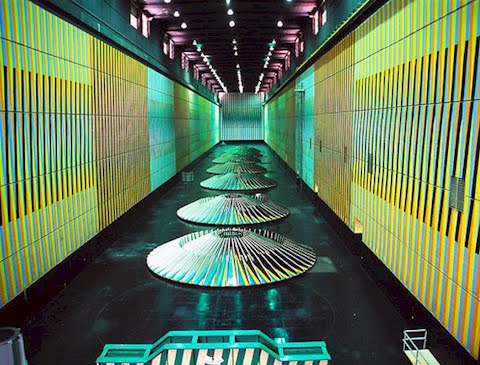
Hydroelectric Turbines in a Venezuelan Dam Complex

I am going to do a followup to my previous entry on The Coming Electrical Power Disaster in Venezuela, this time by way of posting a translation of an article originally published in Venezuela's Revista Zeta magazine in late January, but which you can now see in its original Spanish on the Victor Poleo portal at Soberania.org.  The article presents an interview with Poleo, who has now become regarded as the most knowledgeable critic of Chavez's energy policies writ large, but especially with respect to the electrical power shortage that is now doing such serious damage to the country and which has also become a major political issue.

I would suggest that everyone pay attention to two very important points Poleo makes in the interview, how the deprofessionalization of Venezuela's electric sector has led to gross mismanagement of the various EDELCA dam complexes in the country, whose water levels have been depleted unnecessarily according to Poleo; and the problems with the accounting for about 70% of the $35 billion dollars that has been appropriated for the electric sector between the years 1999 - 2009.  Since deprofessionalization itself is evidence of the corruption of the Chavez regime, which has removed competent professionals from key jobs within government-run operations throughout the electric sector in order to award employment to political favorites, the price Venezuelans are paying for it can barely be estimated when grouped together with tens of billions of dollars worth of unaccounted appropriations.  It is a striking and near-unbelievable story which pretty much speaks for itself.

TRANSLATION:
"It Is Not Guri’s Fault"
By Aida Gutierrez
Interview with Victor Poleo Uzcátegui
Revista Zeta (Venezuela)
January 28, 2010, No. 1740-22

According to the ex-Electricity Director of the Ministry of Energy, Victor Poleo Uzcátegui, a preliminary estimate indicates that $50 billion was put into the Electrical Sector between the years 1999-2009, but scarcely 30% was spent on power generation and transmission projects. The delays in maintenance and expansion are dramatic.

"The country does not depend on Guri alone and what is happening is that a vile story is being spread from the presidency which attributes the current crisis to the Caroní hydroelectric complex," engineer and ex-Electricity Director Victor Poleo Uzcátegui stated in an exclusive interview with Zeta.

Poleo finds himself very busy and much in demand these days, as the foreign press turns to him to know and understand what is happening with electricity in Venezuela, paradoxically, now called "energy power."

As a preface to the interview the expert began to talk of the Lower Caroní, a system of cascading water hydroelectric dams:

Lower Caroni Dam Complexes
Dam ComplexStartup DateDaily OutputDelays?
Macagua I1961370 MW 
Guri I19683,000 MW 
Guri II19866,100 MW 
Macagua II19952,300 MW 
Macagua III1995360 MW 
Caruachi20042,300 MW(Delay of 2 years)
Tocoma20142,300 MW(Delay of 7 years)

--Guri is a regulated reservoir, the water passed through turbines in Guri is afterwards passed along to the lower dams in the following order: Tocoma, Caruachi, and Macagua.

Lower Caroni 1992:  EDELCA Projects of the Lower Caroní in 1992 - Note the startup operation dates entered for Caruachi and Tocoma, 2002 and 2007 respectively. Compare these with table above, which shows delays under Chavez.

--The Lower Caroni system by itself--he explains--does not satisfy national demand for electric power, he specified, but interacts with an accompaniment of thermoelectric centers, which use natural gas, diesel, and fuel oil as combustible fuels. Coal and orimulsion oil are also thermoelectric combustible fuels.

--The water of the Guri reservoir is from unsteady-state influx, i.e. the contributions to the Caroní Basin fluctuate historically between 6,500 and 3,500 cubic meters per second, according to records from 1950 to the present.

He pointed out that thermal power generation is from fixed-state influx, i.e. plant machinery such as at Planta Centro or Tacoa or Arrecifes can be activated in a short time.

"The art of mixing water power generation with thermal power generation is the art of optimizing the usage time of the Guri reservoir. On the one hand, one does not want to reduce the amount of water stored in Guri to too low a level because there will be barrels of combustible fuels lost to make up the shortfall. On the other hand, one does not unnecessarily "burn" barrels of thermoelectric combustibles” (if there is water in the reservoir) Poleo made clear.

--There then exists--he continues--an optimum mix of the hydro-thermal electric power system. To master and administrate such a formidable and complex task mathematical models are used, a kind of laboratory in which they simulate reservoir water levels over time compared against national electric power demand and then they "dispatch" the generation of hydro or thermal electric power in real time but placed within a future horizon.

--This task rests within the hands of the National Management Center (CNG), formerly OPSIS, which uses two types of "dispatch." One in real time (hours, days) which is operational dispatch. Another is in medium and long term planning, over 5 to 10 years.

--In Venezuela--the expert continued--mathematical models exist for load dispatch. One of them is PLHITER (Spanish acronym for Hydro-Thermal Planning), developed by a team of Venezuelan engineers and mathematicians, in use since the mid-80's by EDELCA, CADAFE, and CNG (formerly OPSIS).

He obligingly clarified that PLHITER is therefore an instrument of planning.

Those responsible for the electric power crisis

Poleo considers that "the deprofessionalization of the Electrical Sector since 2003 has become an infringement upon the planning of the Venezuelan electrical sector, also a consequence of the "anti-planning" of the nation, a task which rests in the Ministry of Planning, but a task they have taken up irresponsibly, like the President of the Republic in his Sunday outbursts.

--The electrical sector--he stresses--doubles its investment every 15 years, as a function of demographic growth and industrial activity. Medium and long term plans existed in 2000, but the projects were not implemented thanks to embezzlement, waste and corruption.

Electrical sector funding and spending

--It is our ongoing estimate that during the period 1999-2009 money appropriated to the Electrical Sector can be placed on the order of at least $50 billion (U.S.), according to the following:


Electrical Power Sector Budgetary Inputs:  1999 - 2009
1Ordinary fiscal budget$7 billion
2Additional Appropriations$700 million
3Electrical Power Invoices$27 billion
4Additional spending (preliminary)$15 billion


--To judge by the thermoelectric power station's current shortages and based upon a sampling of CADAFE projects, it is our conjecture that scarcely 30% of the power generation and transmission projects were carried out.

Note:  The Planta Centro Thermoelectric Plant is now completely out of service and inoperational and the Uribante Caparo Dam Hydroelectric Complex was no longer producing electrical power as of January, 2010, which means that the $681 million appropriated for the two projects represents both massive waste and gross mismanagement under Chavez's administration.

--Hence the current electrical crisis, already predicted as of 2000, a consequence of not making the investments in thermoelectric power centers--the specialist assured us.

"Those responsible for the crisis: Jorge Giordani in the Planning Office, Rafael Ramirez in PDVSA-Energy and, responsible for selecting them, Hugo Chavez," Poleo stated.

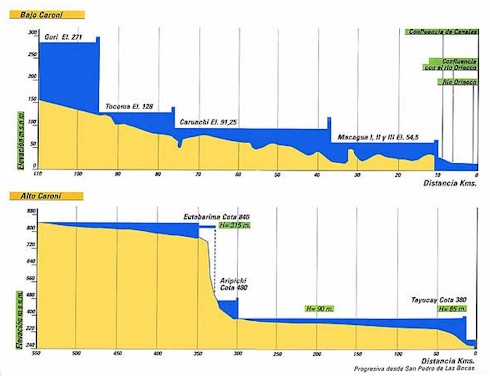
Giordani, in particular, broke the golden rule of strategic planning when he blocked our future options by rejecting hydroelectric power development in the Upper Caroní as far in to the future as 2030.

Lower and Upper Caroní 1992:  Giordani blocked our future options by rejecting hydroelectric power development in the Upper Caroní as far in to the future as 2030.

"The electrical power crisis is a political crisis"

--What is the relationship between Guri's water level and electric power savings?

--On January 10, 2010, the elevation of the water level at the Guri reservoir was measured at 260.58 meters above sea level, or 56% of the usable volume of power-producing water. Today, January 23, 2010, the elevation of the Guri reservoir is measured at 258.20 meters, or 49% of the usable volume of power-producing water at Guri.

--The electrical power "savings" over these two weeks signifies a diminution of 7% of the usable volume, so the trend is predictable.

--Without having the hydro-thermal electric power system, the room to maneuver in the thermoelectric power plants that was announced a thousand times since 2000 and never implemented means that the Guri reservoir will be exhausted in the short term.

--Then from there we will be obliged to ration to look after the value of the water in Guri, which will not be "savings" in the strict sense, only a sub-optimal administration of the Guri reservoir in the presence of thermoelectric deficiencies.

--The government says that the electrical power crisis is generated by the low level of the Guri reservoir. What is your opinion with respect to this statement?

--It sounds reasonable, it is a self-defining truth, a tautology, but the one responsible for the electrical power crisis is the anti-planning and deprofessionalized electrical power sector, amen to criminalizing the unauthorized use of electrical power appropriations.

--Does the rationing of electrical power contribute to resolving the problem?

--It does not "resolve" the current crisis, it only prolongs it, diluting the agony until 2012, in the hope of bringing the thermoelectric power centers online, which are still insufficient in their capacity and scheduled dates to do the job.

--"They should" do as indicated, i.e. maintenance and replacement, for which we require engineering and trade, affairs with which these by the book military men are unacquainted.

--What is happening with the savings in electricity?

--They are cubic meters of water saved for a better time.

--Does the entire country depend on Guri? Is the situation of this reservoir really that dramatic?

The country depends upon a vulgar political class that is intellectually impoverished, irresponsible, and criminal. The country does not depend on Guri--Poleo made clear--and a vile story is being spread around as a message from the presidency that attributes the current crisis to the Caroní hydroelectric complex, "all the eggs are in the same basket," in as much as the Venezuela of the second half of the 20th century rested deservedly upon abundant, clean, cheap, and renewable energy.

--If we did not have the Caroní, today we would be burning the equivalent energy of 570 thousand barrels in gas, diesel and fuel oil. It is a volume we have been left to export. The Caroní adds rent to the petroleum rent.

--CORPOELEC warns that if the water level at Guri continues to fall, in 120 days the production of electricity in the country could collapse. Is this right?

--A problem poorly identified is a problem poorly resolved. There is disinformation from CORPOELEC and, predictably, the warnings from the EDELCA professionals hold true.

--CORPOELEC blundered when it announced pointless rationing in Caracas, a "savings" of 200 MW facing a daily shortfall of 2,000 MW, a deficit that does not include another 2,000 MW which, in theory, they would have to assign using a backup plan that eventually will revolve around rationing power for the use of excess machinery.

--What is your prediction for the electrical power situation in the country? What should we expect and what should be done?

--The electrical power crisis is a political crisis, it does harm to the welfare of society and national economic activity. Shutting down the industries of Guayana City disables its construction materials industry (beams, metal rods, shuttering mesh, fence wire, etc.); the metalworking manufacturing industry (aluminum door and window frames, packaging products, etc.) and in the oil and gas industry (tubing and pipes). A nation without economic activity, a dead Guayana City.

--The solution to the electrical power crisis is political, nothing other than a political change. Urge Chavez to resign and bring about a wise transition into the hands of a sane society that rejects the past and the present, Poleo Uzcátegui recommends.

----------------------------------------------------------

The crisis is nearly unfathomable from our perspective.  There are tens of billions of dollars (U.S.) that have been appropriated and which are now missing, the plant complexes are not producing the electrical power the country needs--some of their most important are either out of operation or stagnant, the Venezuelan economy has been thrown into negative GDP as a result of the energy shortfall, and Chavez's answer is to bring in Cuban advisors whose only expertise is in internet regulation and worse.

This is Venezuela under Hugo Chavez.  Forget the propaganda you read from Venezuelanalysis.com and elsewhere.  Let them tell you the lights are on in Caracas twenty-four hours a day or that the industries Guayana City are not shut down, or ... well, never mind.

StJacques


Read More. . . .

Thursday, February 18, 2010

The Coming Electrical Power Disaster in Venezuela


Guri Dam, Top Provider in the EDELCA Hydroelectric Power Complex

As I posted a couple of weeks ago, there is now evidence from a recent public opinion poll that Venezuelans are turning against Hugo Chavez in huge numbers.  Yeah, as if all that street protest action was not enough to convince anyone.  There are numerous reasons explaining why, but I would like to suggest that the most important come down to issues that are simple and present in the everyday lives of Venzuelans.

Venezuela is currently suffering from a number of economic and social ills.  There have been food shortages and rationing of vital commodities, such as water.  Economic growth has declined, the Bolivar has been devalued in a manner so confusing as to create widespread uncertainty, and if you add runaway inflation into the mix the attendant social consequences become easy to grasp.  Then there is the ever-present threat of violent crime.  But there is one particular problem of everyday life in Venezuela that may be more of a threat to El Primer Bolivariano than all the others, and it certainly will be a major issue in the parliamentary elections this year.

In Venezuela, the lights keep going out.

Origins of the Electrical Power Shortage:  Inattention to Rising Demand

Though there have been periodic problems with electrical power output and distribution over the past several years, things began to take a turn markedly for the worse by at least last September, when regular blackouts became a phenomenon that only added to other domestic ills facing the Venezuelan people.  The Chavez government has since moved with some fervor to restrict consumption of electricity, imposing rolling blackouts as well as announcing a series of what have been at times punitive and almost always confusing public edicts designed to compel Venzuelans to cut their consumption.  And while there are many factors which must be taken into account when explaining the current crisis, the most basic aspect of it is that the supply of electrical power in Venezuela is highly concentrated in the output of a few hydroelectric power installations, most prominently the Guri Dam complexes in the east of the country, which have been unable to keep up with an increase in demand, both for reasons of inadequate rainfall to replenish the reservoir's water levels as well as the inattention given to national energy production on the part of Chavez's regime.

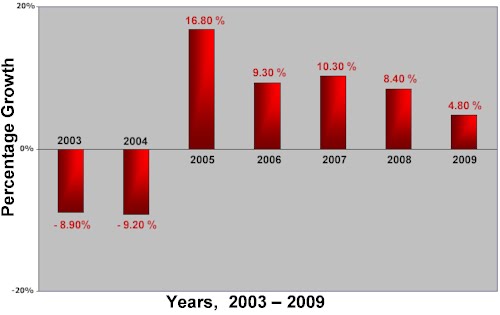
Venezuela's use of electrical power has grown steadily throughout this decade, but its biggest increases mirrored the peak years of expansion of its Gross Domestic Product (GDP).  The critical years of growth in Venezuelan GDP were from 2004 - 2007, when a very rapid expansion fueled by rising oil prices created a more pronounced rise in electrical power use.

   Venezuelan GDP:  2003 - 2009
Source:  indexmundi.com

Figures for Venezuelan electrical power consumption rose most rapidly during the same four years of its explosion in GDP, growing from an average national daily use of 10,951 megawatts (MW) in 2004 to 12,882 MW in 2007, which represents an increase of 17.63% over the entire period, a significant change in aggregate Venezuelan electrical power demand.  The steady rate of growth is also important to note, since it informs us in part of the Chavez regime's forewarning of the present crisis.  If you take the 2004 increase over the previous year and average out the annual yearly percentage increase in electrical power use through 2007 it comes out to average growth rate of 6.05% per year.  With an annual rate of increase that accelerated electrical power consumption in the country at a steady pace, the need to fill growing demand cannot have been unforeseen.  In fact, the first warning of a potentially serious shortfall created by rising demand came from EDELCA, the government-owned Caroni Electrification District (in eastern Venezuela where the major hydroelectric complexes are located), in 2002; an alarm that was supported in later analyses over the next two years.  Chavez and his government were forewarned, but apparently paid little attention, even though dramatic economic growth provided them with the resources needed to address the danger.

Average Daily Demand for Electrical Power:  2002-2012
Source:  Soberania.org

Venezuela's Vulnerability:  Concentration in Supply of Electrical Power

One of the most easily understood aspects of Venezuela's electrical power supply problem is that it is highly-concentrated in just a few hydroelectric power complexes managed by EDELCA for CORPOELEC, the national electric power company, which has an almost monopolistic control over the generation of power in the country.  While there are some smaller producing units involved in EDELCA's organizational structure, the overwhelming majority of their electric power production comes from four main complexes; Guri I and II, Macagua, and Caruachi.  The first three of these dams represent a very long-term construction project for Venezuela, beginning with a plan developed by 1949.  As of 1986 the Macagua and Guri complexes had an installed capacity of 10,000 MW, which though underutilized, was still significant.  The Caruachi complex was the final addition, beginning commercial operation in 2003, but not coming fully online until 2006.

With respect to the structure of Venezuela's electrical sector, the consequence of the Chavez regime's failure to heed the warnings from EDELCA and other experts who predicted an eventual shortfall in the electrical power supply is that it remained highly concentrated in the EDELCA hydroelectric generating complexes of the Guri, Macagua, and Caruachi Dams.  As of last year, some 70% of all electrical power generated in Venezuela originated there, which of course means that the supply would be available only so long as rainfall was sufficient to maintain high water levels in the reservoirs.  But Venezuela had a history of periodic dips in rainfall, as the EDELCA engineers and others had warned, which left the entire country vulnerable to a near catastrophic economic meltdown in the event of the recurring weather phenomenon commonly known as El Niño, which had historically reduced water levels in the several reservoirs before and could potentially do so again.

Average Daily Demand for Venezuelan Electrical Power in 2009
Source:  Soberania.org

Recently, Chavez propagandists and apologists have attempted to explain the current electrical power mess as it relates to the diminished rainfall resulting from the El Niño phenomenon as an unforeseen climatological event.  Unfortunately, Venzuela's own National Institute of Meteorology and Hydrology says differently, making clear they knew that at least three El Niño events over the last two decades had produced drought conditions in the country, especially the last one in 1997-1998:

. . . The effects of El Niño events have been perceived in the national territory, especially during the years 1992, 1996 and 1997-98.  This last event was characterized by deficits in rainfall, drought and positive temperature anomalies in the greater part of the country.  The Caroni River Basin, the main source of hydroelectric power generation of Venezuela, exhibited water flows below the historical average. . . .
National Institute of Meteorology and Hydrology of Venezuela

In spite of an electrical power generating capacity that grew during the Chavez presidency, with the completion of the Caruachi Dam project begun before his term in office, Venezuelan experts who understood the problem of concentrated supply in the Caroni River Basin and its dependence upon uncertain rainfall levels had warned the regime of impending disaster.  But to what effect?

Triunfalismo:  The Chavez Program for Expanding Electrical Power Infrastructure

There has been a lot of triumphant publicity from Hugo Chavez and his government trumpeting their investments in Venezuela's electrical power infrastructure over the past decade, which their propagandists continually tout as evidence of the regime's successes in delivering for the Venezuelan people, but it has been mostly just pure press manipulation.  The real story of actual progress made on the ground in the implementation of plans and programs announced by the regime says something quite different.  Finding credible information which quantifies the reality of Venezuela's electrical power problems is difficult, but the best source one can turn to for what comes closest to accuracy is Victor Poleo, a former Vice Minister for Energy during the first two years of the Chavez presidency, but who has now emerged as one of the regime's most significant, and more importantly most knowledgeable, critics on the subject of energy policy.

Victor Poleo, Venezuela's Vice Minister for Energy from 1999 - 2001

Poleo has described the overall impact of Chavez's energy policy as one filled with "tragic errors", which are especially troubling for the differences between the amounts of state funds appropriated for electrical infrastructure development and those actually spent.  According to Poleo, now at the Universidad Central de Venezuela, who has access to better information than practically anyone outside the government itself, the Chavez regime has, across the eleven years of its administration, put some $35 billion (U.S.) at the disposal of the electric sector for which projects totaling some $7 billion have actually been approved and, of that latter amount, only 30%, perhaps $2.1 billion by inference, has in fact been spent.  And the accounting is troubling:

. . . The efficiency of what was actually spent versus what was appropriated can barely be located between 25% spent on transmission and 50% on generation. . . . There was therefore no disinvestment in the strict sense of the term, that is to say, shortages of money delivered to the electric sector.  The flaw is that there was misappropriation of these funds by the political, militarized, and civilian class, who are tasked with conducting the affairs of the electric sector. . . .
Victor Poleo

Across numerous articles on his portal at Soberania.org, Poleo has delivered a comprehensive and authoritative critique of the Chavez government's complete mishandling of the administration of the electric sector that drives home some of the biggest of the regime's many failures, but in this case, one that has had a noticeable impact upon many Venezuelans.  And where is it all going?  According to a report Poleo has prepared with a panel of related experts, which has recently been made public, a complete collapse of the electric sector is predicted for this year.  And it is not political posturing either.  Even EDELCA's own experts pointed out in December that the collapse was possible by April if national demand was not reduced by 1,600 MW daily.

Victor Poleo has done perhaps as much as anyone to put the lie to the triumphalist public relations campaign the Chavez regime and their propagandists, such as Venezuelanalysis.com, have waged from the beginning with respect to the realities of the electric sector in Venezuela.  There has been a lot of noise, but very little of substance to the regime's energy policy.  And noise is not a good policy choice, nor good politics, when the material well-being of the citizenry is at stake.

We will have much to watch over the ensuing months as the electric power problem in Venezuela unfolds before us and, more importantly, before the Venezuelan people who are apparently aligning themselves behind the opposition in ways we have not seen previously.  The continuing problems of a failing electric power supply can only be expected to accelerate this trend.

StJacques


-------------------------------------------
Acknowledgement:  I would like to post a special message of thanks to Gustavo Coronel, who helped me in my search for credible source information I have used in this investigation.  StJ

Recommended Link: The Electricity Mess of Chavez for Dummies by Daniel Duquenal at Venezuela News and Views.

Update, Thursday, 6:27 p.m.:  Second recommended link - El "por ahora" se convierte en "¿y ahora?" ("For Now" becomes "What Now?") by Alek Boyd.  Though the entry is in Spanish, it contains a short video clip filmed during a blackout of a common citizen who has supported Chavez in the past who is now rethinking his earlier views and recognizes that backing Chavez was a mistake.  Alek has included sub-titles captioning the video in English.  I mentioned at the beginning that matters which affect the lives of ordinary Venezuelans are becoming the source of newfound opposition to Chavez.  Take a look and see for yourself.  StJ

Read More. . . .