Showing posts with label Venezuela Opposition. Show all posts

Friday, March 5, 2010

The "Spanish Indictment" and More:  Hugo Chavez's Ties to Basque Terrorists, the FARC, Narcotics Smuggling, etc.


Spanish Judge Eloy Velasco, left

I want to begin by posting an acknowledgement to Venezuelan blogger Pedro Burelli, who has brought together seven "exhibits" that are all currently in the news regarding Hugo Chavez and his numerous connections to international terrorist and narcotics smuggling operations in a post published Tuesday in both English and Spanish, Exposing Hugo Chavez.  Pedro's compilation of these issues presents a remarkably compelling accumulation of seven related controversial news items now at hand, three of which were developed in an indictment issued by Spanish National Court (Audiencia Nacional) Judge Eloy Velasco of six ETA (Basque Terrorist) and seven Colombian FARC members for a variety of offenses, including the planning of two separate attempts to assassinate two Colombian presidents, a third plot to assassinate Spanish Premier Jose Maria Aznar, weapons and bomb-making support for terrorist attacks, and large scale drug smuggling operations.  The indictment also specifically cited Hugo Chavez's government for facilitating much of this nefarious activity and the Spanish government has requested an explanation from Venezuela.  And even beyond all this there is also a developing international effort in which the U.S. government is now involved to bring Venezuela into the limelight for human rights violations following the recent release of the OAS's joint Inter-American Committee on Human Rights (IACHR) Report on Democracy and Human Rights in Venezuela.

There is a lot to cover here, but since so much of it derives from the Spanish court's actions, I want to provide some additional commentary on the legal proceeding from the American perspective, because I think the court case brings together several matters which deserve rather close examination.

Background to the Indictment:  The Veracity of the Documents from the Reyes Laptops

It has now been two years since the Colombian Army's raid on the FARC encampment just across the Ecuadoran border which netted one of the great intelligence finds of recent years, the laptops of FARC leader Raul Reyes, whose authenticity was verified by an Interpol investigation.  The Interpol examination of the contents of the laptops that immediately followed was, in and of itself, the topic of some rather muddled, and at times inane, attacks from leftist apologists and propagandists who sought to discount their validity as evidence, perhaps guessing correctly that the international ties to Hugo Chavez and the terror and narcotics trafficking of the FARC would not serve the Bolivarian leader very well.  Indeed!  Just ask the Spanish National Court what they think of Hugo.

But let us set aside the noise surrounding the Reyes laptops for the moment, the fact of the matter is that the National Court of Spain has reviewed Interpol's work and understands that the facticity of the Reyes documents has been proved, and that there is now substantial reason to move on and address the meaning of their content within legal proceedings.  This leaves those of us in the western hemisphere to hang our heads in shame as we realize that it took a Spanish court to bring the terrifying implications of Hugo Chavez's misconduct into the light of day.  And for anyone who was as angry as me that OAS Secretary General Jose Miguel Insulza refused to investigate the documentary content of those laptops; well, just read Eloy Velasco's decision and you will understand.  If only George Bush had a pair, we would have pressed an issue that truly would have made the War on Terror something more than a largely cultural conflict played out in the Middle and Near East.  Sigh!

Velasco's Case:  An Opportunity to Demonstrate the Fair Use of the Rome Treaty?

From the American perspective, there is one additional thing to grasp about the Spanish National Court's actions; they have met the test of "Legal Standing" (Locus Standi) as defined within American jurisprudence that is, in the view of most American critics, absent from the Rome Treaty's provisions for taking a case to the international criminal court, and which forms the basis for the greater part of U.S. objections to its ratification.  No matter what may come of the legal proceeding Judge Velasco's court has proferred, its foundation in law is rooted in the fact that, not only are many of the ETA suspects Spanish citizens, but several of the crimes mentioned in the indictment occurred on Spanish soil.  Others, while planned or plotted in South America, were nonetheless intended for execution in Spain.  These crimes include the unrealized plot of 2003 to assassinate then Colombian President Andres Pastrana and Colombia's Ambassador to Spain Noemi Sanin on Spanish territory, a 2004 plot to assassinate then Spanish Premier Jose Maria Aznar with surface to air missiles, and more.  In both of the aforementioned plots the ETA had the cooperation of FARC leaders Raul Reyes and Ivan Marquez; the latter has resided openly in Venezuela for several years and has enjoyed the company of Hugo Chavez himself publicly.

Ivan Marquez of the FARC with Hugo Chavez

If supporters of the Rome Treaty who are critical of the U.S. for its failure to ratify it wanted a test case to demonstrate the utility of the pact while also adhering to the American standard of legal standing, this would be it.  But unfortunately, in my opinion, those supporters are not likely to rally to this particular judicial proceeding because they are much more interested in its polemical use in matters such as the Guantanamo Bay prisoners controversy.  The Velasco case presents a unique opportunity to establish the basis for amending the Rome Treaty to accommodate American reservations, using the example of sound jurisprudential practice as instructive of a proper use of international criminal proceedings, but which will likely go unsupported.  And that is a pure shame, because I believe that if the governments of Europe, who are common signatories to the Rome Treaty, were to support the Spanish Indictment diplomatically, the basis for a common understanding between the U.S. and the international community could be developed to amend the pact and bring in the Americans.  But I personally doubt that the governments of Europe and Latin America have the stomach for meaningful action here or elsewhere.

The Spanish Indictment

There are three relevant items that stem from the Spanish court's decision, as Pedro Burelli listed them, and which are worth repeating here:

  • Colombia's Request for an Explanation from Chavez Regarding Separate Assassination Plots Against Two Colombian Presidents


  • Taken from the Bogota newspaper El Tiempo, in which former President Andres Pastrana declares that Chavez owes the explanation, while sitting President Alvaro Uribe counsels "prudence," though the Spanish Ambassador to Colombia has been called in for a "followup" to the affair.

  • Cooperation of Venezuelan Government in Facilitating ETA and FARC Collaboration is Evident


  • From the Spanish newspaper El Pais, we have Judge Velasco's own words in the decision, there was "Venezuelan governmental cooperation in the illicit collaboration between the ETA and the FARC."  (Underline emphasis mine).

  • Statement of the Government of Spain Requesting an Explanation from Venezuela


  • Confirmation of the official request came from Spanish Prime Minister Jorge Luis Zapatero in Germany, as reported in Spain's El Mundo newspaper.  "We are awaiting clarification from Venezuela and, according to that explanation, so will the government of Spain act."

    The above three items, which include the expressed statements of two national governments in matters of foreign affairs and the conclusion of the Spanish National Court, all directly implicate Hugo Chavez's government as both a facilitator and sponsor of terrorist conspiracies against two other nations.

    But returning to Pedro Burelli's post, there has been other news from the U.S. government over the past nine months which supports the Spanish Indictment, some of which is now worth reviewing.

    Relevant U.S. Government Complaints About Chavez's Misconduct:  July, 2009 - March, 2010

    American government complaints center upon narcotics, support for terrorism, and human rights abuses.

  • U.S. Department of State Links Venezuelan Security Forces to Support of Foreign Terrorist Organizations (FTOs)


  • The State Department's International Narcotics Strategy Control, Vol I publication of March 1 states that "There is strong evidence that some elements of Venezuela’s security forces directly assist these FTOs (foreign terrorist organizations)." (p. 16).

  • U.S. Government Accounting Office (GAO) Report of July, 2009 on Venezuelan Provision of Safe Haven and Support for Armed Colombian Groups Engaged in Narcotics Smuggling Raised Again


  • The GAO Report to the Senate's Committee on Foreign Relations states that "Venezuela has extended a lifeline to Colombian illegal armed groups by providing significant support and safe haven along the border. As a result, these groups, which traffic in illicit drugs, remain viable threats to Colombian security. A high level of corruption within the Venezuelan government, military, and other law enforcement and security forces contributes to the permissive environment, according to U.S. officials." (p. 2)  These conclusions from last year are given new weight by the Spanish Indictment.

  • Senators Richard Lugar and Christopher Dodd Request the OAS to Take Up the IACHR Report on Democracy and Human Rights Violations in Venezuela in Open Session; March 1, 2010


  • In a joint bi-partisan statement Senators Lugar and Dodd asked the U.S. Mission at the OAS to have the report openly discussed at its Permanent Council stating they (Lugar and Dodd) were "deeply disturbed by some of the [IACHR] report’s observations" especially with respect to its findings on the erosion of an independent judiciary, which has led to "the use of the State’s punitive power in Venezuela to criminalize human rights defenders, judicialize peaceful social protest, and persecute political dissidents through the criminal system."

    To wrap up the remainder of Pedro Burelli's post, he also mentions the IACHR report itself, cited in paragraph one above, and the Annual Report of the United Nations International Narcotics Control Board for 2009, which notes that cocaine seized in Africa has in many cases been smuggled through Brazil and Venezuela.

    As to what will come of all this, my guess is not very much in the short term, because Chavez can still count upon the international support of Brazil, Argentina, Bolivia, and Ecuador to protect him.  Over the past several years this has also included Jose Miguel Insulza, but his stock appears to be falling currently in light of his pursuit of re-election to the OAS Secretary General's job and, thankfully in my opinion, it now appears that he probably will not succeed in this regard, owing primarily to the opposition of the U.S., for numerous reasons which are now evident.  But the international calculus in the region is clearly against Chavez, who is becoming a true pariah more and more with each day.  That is a process which is likely to continue unabated, since Hugo does not appear likely to reform his conduct anytime soon.

    Of perhaps greater import is how this is all playing within Venezuela itself.  All the indicators are that its people are turning against Chavez, including many of his former supporters.  This news must certainly hasten that trend.  The big test for this year will be the parliamentary elections and, if the Venezuelan people show enough activism in opposition to Chavez's hand-picked candidates, Venezuela's internal political climate may begin to experience a sea change that reverses the deterioration of democratic freedoms and human rights abuses of the last eleven years. 

    But the world must continue to pay attention.  Chavez must be kept in the spotlight.

    StJacques

     
    P.S. -- Good work Pedro!


    Read More. . . .

    Thursday, February 18, 2010

    The Coming Electrical Power Disaster in Venezuela


    Guri Dam, Top Provider in the EDELCA Hydroelectric Power Complex

    As I posted a couple of weeks ago, there is now evidence from a recent public opinion poll that Venezuelans are turning against Hugo Chavez in huge numbers.  Yeah, as if all that street protest action was not enough to convince anyone.  There are numerous reasons explaining why, but I would like to suggest that the most important come down to issues that are simple and present in the everyday lives of Venzuelans.

    Venezuela is currently suffering from a number of economic and social ills.  There have been food shortages and rationing of vital commodities, such as water.  Economic growth has declined, the Bolivar has been devalued in a manner so confusing as to create widespread uncertainty, and if you add runaway inflation into the mix the attendant social consequences become easy to grasp.  Then there is the ever-present threat of violent crime.  But there is one particular problem of everyday life in Venezuela that may be more of a threat to El Primer Bolivariano than all the others, and it certainly will be a major issue in the parliamentary elections this year.

    In Venezuela, the lights keep going out.

    Origins of the Electrical Power Shortage:  Inattention to Rising Demand

    Though there have been periodic problems with electrical power output and distribution over the past several years, things began to take a turn markedly for the worse by at least last September, when regular blackouts became a phenomenon that only added to other domestic ills facing the Venezuelan people.  The Chavez government has since moved with some fervor to restrict consumption of electricity, imposing rolling blackouts as well as announcing a series of what have been at times punitive and almost always confusing public edicts designed to compel Venzuelans to cut their consumption.  And while there are many factors which must be taken into account when explaining the current crisis, the most basic aspect of it is that the supply of electrical power in Venezuela is highly concentrated in the output of a few hydroelectric power installations, most prominently the Guri Dam complexes in the east of the country, which have been unable to keep up with an increase in demand, both for reasons of inadequate rainfall to replenish the reservoir's water levels as well as the inattention given to national energy production on the part of Chavez's regime.

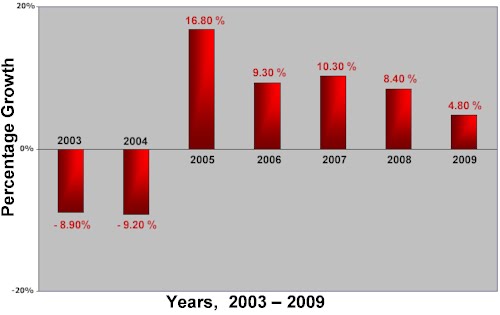
    Venezuela's use of electrical power has grown steadily throughout this decade, but its biggest increases mirrored the peak years of expansion of its Gross Domestic Product (GDP).  The critical years of growth in Venezuelan GDP were from 2004 - 2007, when a very rapid expansion fueled by rising oil prices created a more pronounced rise in electrical power use.

       Venezuelan GDP:  2003 - 2009
    Source:  indexmundi.com

    Figures for Venezuelan electrical power consumption rose most rapidly during the same four years of its explosion in GDP, growing from an average national daily use of 10,951 megawatts (MW) in 2004 to 12,882 MW in 2007, which represents an increase of 17.63% over the entire period, a significant change in aggregate Venezuelan electrical power demand.  The steady rate of growth is also important to note, since it informs us in part of the Chavez regime's forewarning of the present crisis.  If you take the 2004 increase over the previous year and average out the annual yearly percentage increase in electrical power use through 2007 it comes out to average growth rate of 6.05% per year.  With an annual rate of increase that accelerated electrical power consumption in the country at a steady pace, the need to fill growing demand cannot have been unforeseen.  In fact, the first warning of a potentially serious shortfall created by rising demand came from EDELCA, the government-owned Caroni Electrification District (in eastern Venezuela where the major hydroelectric complexes are located), in 2002; an alarm that was supported in later analyses over the next two years.  Chavez and his government were forewarned, but apparently paid little attention, even though dramatic economic growth provided them with the resources needed to address the danger.

    Average Daily Demand for Electrical Power:  2002-2012
    Source:  Soberania.org

    Venezuela's Vulnerability:  Concentration in Supply of Electrical Power

    One of the most easily understood aspects of Venezuela's electrical power supply problem is that it is highly-concentrated in just a few hydroelectric power complexes managed by EDELCA for CORPOELEC, the national electric power company, which has an almost monopolistic control over the generation of power in the country.  While there are some smaller producing units involved in EDELCA's organizational structure, the overwhelming majority of their electric power production comes from four main complexes; Guri I and II, Macagua, and Caruachi.  The first three of these dams represent a very long-term construction project for Venezuela, beginning with a plan developed by 1949.  As of 1986 the Macagua and Guri complexes had an installed capacity of 10,000 MW, which though underutilized, was still significant.  The Caruachi complex was the final addition, beginning commercial operation in 2003, but not coming fully online until 2006.

    With respect to the structure of Venezuela's electrical sector, the consequence of the Chavez regime's failure to heed the warnings from EDELCA and other experts who predicted an eventual shortfall in the electrical power supply is that it remained highly concentrated in the EDELCA hydroelectric generating complexes of the Guri, Macagua, and Caruachi Dams.  As of last year, some 70% of all electrical power generated in Venezuela originated there, which of course means that the supply would be available only so long as rainfall was sufficient to maintain high water levels in the reservoirs.  But Venezuela had a history of periodic dips in rainfall, as the EDELCA engineers and others had warned, which left the entire country vulnerable to a near catastrophic economic meltdown in the event of the recurring weather phenomenon commonly known as El Niño, which had historically reduced water levels in the several reservoirs before and could potentially do so again.

    Average Daily Demand for Venezuelan Electrical Power in 2009
    Source:  Soberania.org

    Recently, Chavez propagandists and apologists have attempted to explain the current electrical power mess as it relates to the diminished rainfall resulting from the El Niño phenomenon as an unforeseen climatological event.  Unfortunately, Venzuela's own National Institute of Meteorology and Hydrology says differently, making clear they knew that at least three El Niño events over the last two decades had produced drought conditions in the country, especially the last one in 1997-1998:

    . . . The effects of El Niño events have been perceived in the national territory, especially during the years 1992, 1996 and 1997-98.  This last event was characterized by deficits in rainfall, drought and positive temperature anomalies in the greater part of the country.  The Caroni River Basin, the main source of hydroelectric power generation of Venezuela, exhibited water flows below the historical average. . . .
    National Institute of Meteorology and Hydrology of Venezuela

    In spite of an electrical power generating capacity that grew during the Chavez presidency, with the completion of the Caruachi Dam project begun before his term in office, Venezuelan experts who understood the problem of concentrated supply in the Caroni River Basin and its dependence upon uncertain rainfall levels had warned the regime of impending disaster.  But to what effect?

    Triunfalismo:  The Chavez Program for Expanding Electrical Power Infrastructure

    There has been a lot of triumphant publicity from Hugo Chavez and his government trumpeting their investments in Venezuela's electrical power infrastructure over the past decade, which their propagandists continually tout as evidence of the regime's successes in delivering for the Venezuelan people, but it has been mostly just pure press manipulation.  The real story of actual progress made on the ground in the implementation of plans and programs announced by the regime says something quite different.  Finding credible information which quantifies the reality of Venezuela's electrical power problems is difficult, but the best source one can turn to for what comes closest to accuracy is Victor Poleo, a former Vice Minister for Energy during the first two years of the Chavez presidency, but who has now emerged as one of the regime's most significant, and more importantly most knowledgeable, critics on the subject of energy policy.

    Victor Poleo, Venezuela's Vice Minister for Energy from 1999 - 2001

    Poleo has described the overall impact of Chavez's energy policy as one filled with "tragic errors", which are especially troubling for the differences between the amounts of state funds appropriated for electrical infrastructure development and those actually spent.  According to Poleo, now at the Universidad Central de Venezuela, who has access to better information than practically anyone outside the government itself, the Chavez regime has, across the eleven years of its administration, put some $35 billion (U.S.) at the disposal of the electric sector for which projects totaling some $7 billion have actually been approved and, of that latter amount, only 30%, perhaps $2.1 billion by inference, has in fact been spent.  And the accounting is troubling:

    . . . The efficiency of what was actually spent versus what was appropriated can barely be located between 25% spent on transmission and 50% on generation. . . . There was therefore no disinvestment in the strict sense of the term, that is to say, shortages of money delivered to the electric sector.  The flaw is that there was misappropriation of these funds by the political, militarized, and civilian class, who are tasked with conducting the affairs of the electric sector. . . .
    Victor Poleo

    Across numerous articles on his portal at Soberania.org, Poleo has delivered a comprehensive and authoritative critique of the Chavez government's complete mishandling of the administration of the electric sector that drives home some of the biggest of the regime's many failures, but in this case, one that has had a noticeable impact upon many Venezuelans.  And where is it all going?  According to a report Poleo has prepared with a panel of related experts, which has recently been made public, a complete collapse of the electric sector is predicted for this year.  And it is not political posturing either.  Even EDELCA's own experts pointed out in December that the collapse was possible by April if national demand was not reduced by 1,600 MW daily.

    Victor Poleo has done perhaps as much as anyone to put the lie to the triumphalist public relations campaign the Chavez regime and their propagandists, such as Venezuelanalysis.com, have waged from the beginning with respect to the realities of the electric sector in Venezuela.  There has been a lot of noise, but very little of substance to the regime's energy policy.  And noise is not a good policy choice, nor good politics, when the material well-being of the citizenry is at stake.

    We will have much to watch over the ensuing months as the electric power problem in Venezuela unfolds before us and, more importantly, before the Venezuelan people who are apparently aligning themselves behind the opposition in ways we have not seen previously.  The continuing problems of a failing electric power supply can only be expected to accelerate this trend.

    StJacques


    -------------------------------------------
    Acknowledgement:  I would like to post a special message of thanks to Gustavo Coronel, who helped me in my search for credible source information I have used in this investigation.  StJ

    Recommended Link: The Electricity Mess of Chavez for Dummies by Daniel Duquenal at Venezuela News and Views.

    Update, Thursday, 6:27 p.m.:  Second recommended link - El "por ahora" se convierte en "¿y ahora?" ("For Now" becomes "What Now?") by Alek Boyd.  Though the entry is in Spanish, it contains a short video clip filmed during a blackout of a common citizen who has supported Chavez in the past who is now rethinking his earlier views and recognizes that backing Chavez was a mistake.  Alek has included sub-titles captioning the video in English.  I mentioned at the beginning that matters which affect the lives of ordinary Venezuelans are becoming the source of newfound opposition to Chavez.  Take a look and see for yourself.  StJ

    Read More. . . .

    Sunday, February 14, 2010

    Martha Colmenares on the Futility of the Vote in Venezuela


    I am going to post a translation of an article written by Martha Colmenares for Diario de América last year following Venezuela's second national referendum on extending the term limit for the office of President, which Hugo Chavez called by executive decree, after losing an earlier vote by a significant margin.  The "official results"--i.e. "the lie"--of the vote were reported as a Chavez victory, supposedly giving him a one million vote margin along with the option of continuing his presidential mandate indefinitely, which is where things now stand.  Obviously I do not believe the vote was as announced, but that is another story altogether, part of which will be told in this blog entry.

    Before I get to the translation I want to offer an apology to Martha for my incorrect use of the term Ni-Nis, roughly translated as "neither-nors," as one that applies to all electoral abstentionists, which I used in my post of yesterday, as well as in comments I made within a forum discussion on her web site.  Martha has corrected me, pointing out that the term really applies most of all to the apathetic within Venezuelan political life who will not vote for either Chavez or his opposition.  Martha would be much better described as a willful abstentionist who seeks other means to bring about change in Venezuela.  Though I adopted the usage of the term from others, that is no excuse.  Martha is one of the most dedicated bloggers anywhere when it comes to the issues affecting human freedom and democracy and she deserves to be treated with genuine deference for all she has done.

    As a gesture of my sincere respect, and indeed admiration, for Martha and her work I have decided to translate an article which states her own view of the futility of Venezuelan politics in very clear terms.  I think everyone will be able to see that there is a solid foundation of evidence to prove that the electoral system under Chavez has been corrupted totally, I know I am convinced, and whatever one's outlook may be on the path to hopeful change, dealing with the electoral hurdle is a most significant problem.

    Martha's answer to the obvious question of how Chavez can be confronted successfully and Venezuela reformed for the better is Mass Civil Disobedience.  I certainly do not argue with the proposal, though I do not see it as antithetical to electoral political activism.  And I especially should mention that when the moment comes for Chavez to go, I do not expect it will be as the consequence of an election result all by itself.  No; Chavez will have to be forced out in one way or another, I just believe that the electoral process must be part of the mix of the witches brew that will have to be concocted to make him leave.

    I will let Martha tell her story in a way English-language readers can understand.  And with everything I know about her I want to take this moment to say that I know the story she tells is the truth.  You can believe Martha Colmenares.

    TRANSLATION:
    Chavez's Rigged Election Was Announced
    February 17, 2009

    Illegally, the official vote counts do not reflect real votes, and the regime does not even have to reveal the official results.

    By Martha Colmenares

    Introduction: Chavez's grand strategy is to continue balancing the appearance of democracy with the reality of totalitarianism.

    The main thing is that in a country where there is no law, whether one votes or not does not matter. The reason why it does not matter is very clear: The regime says what the results of the voting are and its word is final, as happened in the referendum last December 2, 2007, so that one has every reason to believe that the amendment's rejection was overwhelming, nevertheless, the regime also stated that the decision was almost a tie, and there left the matter to rest, and there was no legal recourse to know the official results, which certainly have little to do with the actual results.

    This says that, without legal restraints, the official vote counts do not reflect actual votes, and the regime does not even have to reveal the official results. It might be a first reason for understanding that whether one votes or not does not matter.

    The second reason is that you can win every amendment referendum in the world, and reform still proceeds as if Chavez had won instead. There can be no forgetting that the dictator Gómez governed Venezuela, literally, from his home for decades without being president of the republic.

    Chavez can put any candidate on the ballot as he pleases, including the terrorist "The Jackal", and still have himself elected President, so that he remains the boss, and everyone knows that he is the one giving orders. And if any corrective action is needed, then once again he can amend the constitution to create the office of "Head of Government", or "Head of State," "Meritorious Hero," "Lord Protector", "Ayatollah", etc., in a way in which Chavez continues being the one who gives orders.

    To illustrate this nothing more is needed than to see what happened with the constitutional reform that was rejected scarcely one year ago: the regime submitted it anew, and again, there was no legal recourse to stop it.

    The third reason is the farce that we are seeing today, that we voted on the same thing that was rejected one year ago. If this is the way things really were, we would have a presidential recall referendum every year as well, but as it turns out, since there is no law, the regime may submit the same referendum as many times as it wants to win it, but when it is opposed, then it is spared and it denies the right of people to decide, as happened when we rejected the consultative referendum, the recall petition signatures, re-signatures, all the damned signatures.

    The fourth reason is that there was no reason to pay attention to the call of those who showed up to vote NO on that occasion, because those people are the same ones who time and again were called upon for a vote against the regime and then left it to steal the election.

    Chavez's grand strategy is to continue balancing the appearance of democracy with the reality of totalitarianism. That is, one must recognize that Chavez has been very competent in maintaining the balance by allowing a little bit of criticism within the mass media to maintain the appearance of freedom of expression as he goes about censoring that criticism, keeping it at a "simmer"; while today, he has already shut down Radio Caracas's public signal, bought those of Venevisión, and by terrorizing journalists, newspapers, radio and television stations, he has created a climate of self-censorship that is steadily becoming more effective in silencing criticism altogether.

    When a naive person from afar asks: "But if Chavez is another gorilla, where are the thousands of disappeared or incarcerated journalists?", and there is no response, then that naive person becomes bored and no longer believes that there is a tyranny.

    The same thing is done with elections. Another balancing act, on the one hand creating the appearance of democracy, while on the other, through the use of official advantadge (i.e., using all the nation's resources to promote his candidates), through the biased application of laws, vote fraud, and by reholding elections he loses (which by the way, as he did last year, Chavez at times accepts a defeat here, as in government office X, or there, as in referendum Y), gaining the appearance of having his agenda approved by democratic elections.

    The farce is sufficiently well done so that both the dumb as well as the vivacious (those who get the most from Chavez) gain from the world they created, with each new election bringing another turn of the nut of totalitarianism.

    It bothers me that most of those who call themselves opponents of the Chavez regime resign themselves to playing his balancing game, to me it is very clear that in this manner they do not achieve anything more than giving him the legitimacy he needs to put an end to the awakening of the world community who would be the only ones who could put the brakes on him, giving shelter to the defenders of democracy in Venezuela and denying him international support for his regime.

    The reason why there are politicians in Venezuela still calling people out to vote is easy to explain: To legitimize the regime in elections means that the regime has to concede just a small share of its power to them, and that is what politicians calling people out to vote are seeking.

    As we have seen, it matters little whether or not people elect an opponent of Chavez, because if they elect a Chavista, the one they choose steals what is dear to people, and if they choose an anti-Chavista, then the Chavez regime takes away resources and designated authority (as is happening with the recently elected governors and mayors) only to give those resources and powers to their own followers so that they in turn become the ones who do the stealing. Therefore I say that the people are screwed every which way.

    Indeed, it seems appropriate to clarify that although Chavez has been competent in maintaining the critical balance, he has stumbled more than once, including in April 2002, which, we remember, was because Chávez needed to purge the oil industry of qualified personnel to fill it with his most loyal supporters, and then, he created that huge provocation by humiliating and insulting its managers so as to force his opposition to reveal itself in protests; the problem is that the provocation was so great that the protest literally spun out of control and he lost the presidency when he ordered the killing of some of the two million protesters demanding his resignation and was disobeyed.

    Which brings me to the last part of this introductory reflection, the manner of defending democracy in Venezuela is not voting, because in that way what can be achieved at the ballot box (if anything!) is lost a little at a time indirectly legitimizing the Chavez regime which does exactly the opposite of what was won at the polls; but rather by DISOBEYING. The regime must be disobeyed in every way possible; but before doing so, we must organize ourselves so that everyone acts at the same time.

    What happened this past February 15th, 2009 in the process of voting on the term limit amendment?

    In a shameless use of official advantadge, motorized gangs intimidated the citizenry starting at dawn, up to the point where Chavista bands injured people with baseball bats and chains. It happened the day before and the leadership of the CNE turned a blind eye. Of course that went unpunished. So be it, the proclamation of victory went out on the state channel with that of Chavez's own PSUV party, when it was prohibited, as ordered by the man himself, so that they would close any media outlet that issued anticipated results.

    How could they know the results as early as 4 pm? Clearly, that is why they lengthened the process two more hours, when voting hurriedly was not justified. At 4 p.m. the "No" votes exceeded the "Yes" by more than 10.5% and they then nailed it down, using WI-Fi communications between 4 and 6 p.m.; the Chavistas were supposedly celebrating their victory already at 4 p.m.

    A pro-Chavez governor voted twice, tore up ballots, committed electoral crimes and nothing was done, on the other hand the student leadership was raided by state security forces according to some five witness affidavits.

    Chavez used the daily television channels to insult us, everything that gave him pleasure, he told us he was going to grind us up dozens of times. What does this mean? That Chavez was bragging about his rigged election.

    Rigging the electoral registry, the disaster of the voting machines and, is there anything here that Chavez does not own? The Supreme Court, National Assembly, electoral office, militias, army, public ministry, money, oil, everything, everything. No one wins against all this.

    In case this is not shameful enough, what about the statements of the "opposition leadership" which legitimized or are legitimizing an electoral office that is controlled by Chavez? They even went so far as to cheerfully recognize the results of five million for the opposition to six for the Chavistas.

    In conclusion, I am ashamed of this "opposition leadership" (which does not represent me) that tries to ignore what can only be called ongoing electoral fraud, and in its place goes on speaking such nonsense as "if they lost it was because of electoral abstention" and speaking poorly of the abstentionists and telling I do not know how many more fairy tales ...


    This is a perspective worth knowing.

    StJacques


    Read More. . . .

    Saturday, February 13, 2010

    Note to the Ni-Nis: "Even If You Lose, You Still Win!"


    I have been trying to concentrate on preparing a post on the issue of electrical power in Venezuela, which is rather complex when all things are considered, but I have found myself distracted by my desire to participate in a fascinating discussion at Martha Colmenares's blog on the subject of electoral abstentionism which I just could not draw myself away from to attend to my own blogging.  I recently posted a translation of an editorial by Venezuelan author Ibsen Martinez which addressed the matter with what I consider to be a sophisticated, articulate, and pragmatic understanding of politics within a representative democracy.  But I am fascinated by the persistent view of many, both within Venezuela and without, who believe that some other option to the vote is the only hope of bringing about a truly democratic result and that therefore they should boycott the electoral process altogether.

    To those who may be unfamiliar with the political process in Chavez's Venezuela, the idea of making it more democratic by abstaining from it may appear to be a course of action without any foundation in reality.  This is not so.  There is absolutely no doubt that Chavez has benefited from electoral fraud conducted on an almost unimaginable scale.  The allegations of this first surfaced in the aftermath of the recall referendum of 2004 in Venezuela, which supposedly were dispelled in a review the Carter Center conducted which discounted them.  But there were serious problems with the Carter Center's examination of the allegations, as a subsequent study prepared by two quantitative analysts from Harvard and MIT demonstrated.  And there is much more, as a series of articles one can still view at VCrisis.com make clear, especially with respect to the unbelievably fraudulent electoral register.  And none of this even begins to touch upon the very alarming issue of two-way modem communication between Smartmatic voting machines and polling places.  There is so much more to electoral fraud in Venezuela under Chavez, but the point here is that the abstentionists have both logic and evidence on their side as they justify their withdrawal from the process, given that the proof of fraud is overwhelming and they have no legal means to address it, since the National Electoral Council (CNE) is totally under Chavez's control.

    But however reasonable the argument of abstentionists that the electoral process in Venezuela is corrupted may be, the consequences of their willful withdrawal from it cannot be discounted either, because it gave Chavez full and total control of Venezuela's National Assembly.  As Ibsen Martinez argued "the result of such nonsense [i.e. militant abstentionism] has been what Chavez has counted upon for four years with an assembly joyously at the service of all his designs."  And I agree wholeheartedly with Martinez.  Turning over the entire ship of state to Chavez has been one of the most calamitous political miscalculations anywhere and the abstentionists must be held to account for it.

    Thus do we return to that forum discussion that has distracted me for these past two days.  Though I am fully in agreement with the analysis so many have offered that a true, democratic result cannot be expected from the Venezuelan electoral system so long as the National Electoral Council serves as nothing more than a rubber stamp for Chavez, the electoral register is fraudulently inflated, two-way communication between electronic voting machines persists without oversight of its code, and the international community will not insist upon a legitimate vote; I am more convinced than ever that abstentionism at this moment will have unbelievably tragic consequences.  At this critical time in Venezuela's recent political history the opposition to Chavez has gained a momentum it has never had before; so much so that the only proper strategy for the Venezuelan resistance to pursue is one of confronting the regime on all fronts, which is precisely what I argued within the forum discussion, where I post under the username "Jacobo."

    But the best point made within that entire exchange was one offered by a poster named Nico Alijuna who pleaded for a strengthening of the ever-growing opposition, which is an undeniable political phenomenon at present, with the simple observation that "if you lose, you still win."  I consider this to be the final word on the folly of abstentionism and I urge those who continue to abstain, the so-called Ni-Nis, to learn from their past mistakes and rethink their actions.  The Venezuelan opposition needs their participation.

    StJacques


    -------------------------------------------------------
    Update, February 14, 10:25 p.m.

    I have posted another entry today in which I correct myself for what I now understand to be a not-altogether acceptable use of the term Ni-Ni, which perhaps should not be applied to all electoral abstentionists, as some are more willful in their rejection of the utility of the vote and remain quite politically active nonetheless.  StJ


    Read More. . . .

    Saturday, February 6, 2010

    Caracas Mayor: "There is a Cuban Invasion Here"


    Metropolitan Caracas Mayor Antonio Ledezma

    I am going to post a translation of an article up yesterday (Saturday) at the Caracas newspaper site El Universal that contains a public statement of a prominent Venezuelan public figure that can only be viewed as representing a direct challenge to the Hugo Chavez regime.  In the article Antonio Ledezma, the mayor of "Metropolitan Caracas"--a somewhat confusing term after the implementation of the Capital District Law of 2009, in which Chavez stripped him of a significant portion of his authority--charges that Venezuelan sovereignty has been significantly compromised by what Ledezma calls a "Cuban invasion."  What I find particularly important about the statement is that the Mayor calls upon the Venezuelan Armed Forces to explain why the country is "being invaded by a foreign government."  These kinds of appeals cannot be going down easy among Chavez's supporters, who understand that the population is in earnest.

    Before I get to the translation itself, there are two matters I wish to address in brief.  First; I would like to give a little background on Antonio Ledezma, who I think is a man Venezuelans, especially those in the capital city, will pay attention to when he speaks.  And second; I want to give a short overview of the issues raised in the mission of Cuban General Ramiro Valdes, perhaps the number three man in Cuba after Fidel and Raul Castro, who has arrived in Venezuela ostensibly to help "fix" the country's electrical power generation problems, but who instead has created widespread fears of an impending campaign of political repression of a much more dangerous sort than we have seen from Hugo Chavez to date.

    Antonio José Ledezma Díaz, 54 years old, has served in Venezuelan public life for almost two decades.  From 1992-1993 he was the Governor of what was then the Federal District of Caracas, an entity that was later abolished.  He later served as Mayor of the Libertador Municipality, which forms part of Greater Caracas, from 1996-2000.  He became one of the first Venezuelan politicians to challenge Hugo Chavez successfully in the Caracas area, generally considered a bastion of Chavismo, in 2008 when he defeated Chavez's hand-picked candidate Aristobulo Isturiz in the Caracas Mayor's race, only to see the National Assembly reduce his power in the already-mentioned Capital District Law of last April.  He is a member of the splinter political party Alianza Bravo Pueblo (Fearless People's Alliance), though he was formerly affiated with Acción Democrática, one of the historical social democratic parties that is now trying to overcome its greatly-diminished power of recent years; in no small part a consequence of their abstentionist political stance in recent elections.

    Cuban General Ramiro Valdes
    Source:  AFP/Getty Images

    In the interview with El Universal I am introducing in this entry, Ledezma raises serious concerns over the expanding presence of thousands of Cuban advisors and military personnel, and which directly references General Ramiro Valdes, formerly Cuba's interior minister and Government Vice President, who recently has been in charge of Cuban internet "regulation."  Those who have followed events in Cuba closely will know that this obviously entails much of the Castro regime's recent repressive acts against Cuban bloggers.  And Valdes's personal history as Interior Minister in Cuba does not inspire confidence among Venezuelans, or anyone else observing honestly for that matter, that the essence of his task relates to repairing Venezuela's very serious electrical power generation problems, which are the source of significant dissatisfaction with Chavez's rule among Venezuelans.  As you will be able to see, Ledezma is absolutely unconvinced that the Valdes mission has anything to do with electrical power generation.

    One other point to mention about the article.  You will notice that the persistent problem of public safety, i.e. "insecurity," again crops up in the interview with Mayor Ledezma, who is obviously seeking to reverse the effects of the Capital District Law of 2009 with respect to the maintenance of public order.  This is a major issue with many in Caracas.

    TRANSLATION:
    "Ledezma:  There is a Cuban Invasion Here"
    03:22 PM Caracas. - The Mayor, Antonio Ledezma, lashed out at the presence in the country of Cuban Minister Ramiro Valdes, and stated that the Armed Forces should explain why Venezuela is being invaded by a foreign government.

    "There is a Cuban invasion here. The president has stated that we have thousands and thousands of Cubans here. What response is there to this? We are thought of as unpatriotic when we make a statement of what is beyond Venezuela," Ledezma said.

    He added "Do they believe that they will scare us with this Cuban? Do they believe they are going to silence society?

    The Mayor considered it "a confession of incapacity, of ineptitude" that we are looking for help in other countries to resolve the electrical crisis, when there are dozens of technicians in Venezuela.

    "Tell this Mr. Valdes that we all know that he is an expert on police terrorism. He will be coming to electrocute Venezuelans because what lessons of efficiency in matters of electrification can this man, who has a criminal record and experience only in matters of persecution and harassment in the Cuban G2, give to us."

    Ledezma also defended the students. "I believe that the students are behaving as they are because they also use a light bulb to see, they know they need water, they are also family members."

    The National Guard is not resolving the problem of security

    The Mayor, Antonio Ledezma, considers that President Hugo Chavez's announcement of sending the National Guard into the streets to combat insecurity in the country does not constitute a real solution to the problem.

    "No one can frown upon the effort but the result of announcing this 6 times more or less, is that every time they go on announcing that the National Guard is heading out into the streets the issue of insecurity gains strength, the guard only shows up at bus stops and afterwards goodbye to the electrical power that's now switched off," the Mayor maintained.

    He said that the National Police have not worked out, and they have not done so because "it was a mistake to put a partisan political label on the police, nowhere in the world are the police socialist, or social christian."

    He suggested the government would be better off taking another look at the decentralization schemes for fighting insecurity that he proposed "instead of harassing the regional police."

    He asked once again that the Metropolitan Police be returned to the city's control in order to "teach them how to manage a security plan" because in his view putting that police force in the hands of the national government has not meant any better pay nor better equipment for them and less security for the citizenry.

    He insisted upon adopting the security plan that he developed with a group of experts headed by Fermin Marmol Leon. "The security plan prepared by a team of specialists has not been dropped."

    In Ledezma's judgement it is impossible for the government to continue hiding in the closet with respect to the subject of security. "There are war parties out every weekend, the President never speaks of insecurity and there are 150 thousand deaths in the 11 years of his tenure.


    In the Blogosphere

    As one might guess, the Venezuelan bloggers have been all over the Valdes mission and they go even farther than does Ledezma in voicing their anxieties about Valdes's past and what it portends for Venzuela.  Among the English-language Venezuelan blogs I would especially recommend Miguel's excellent piece at the Devil's Excrement, "Hugo: How insensitive can you be? Ramiro Valdes is a murderer."  That's spot on the mark, by the way Miguel.  Juan Cristobal has an initial entry piece up at Caracas Chronicles, "Enter Ramirito," which presents an introduction to Valdes and speculates that his real mission is to assist Hugo Chavez in controlling internet and telecommunications use.  Daniel Duquenal at Venezuela News and Views has two interesting posts to read.  He pegs Valdes clearly as "one of the major assassins of an already assassin rich Fidel Castro entourage," as well as a second post which reports that Valdes has been strongly rejected in the country and that those within Chavismo would do well to correct their mistake.

    Among the Spanish-language blogs I would like to point to three at this moment.  Gustavo Coronel posted an excellent entry yesterday on the very topic I am covering here which uses historical allusion to compare Mayor Antonio Ledezma to Alonso Andreas de Ledesma, an honored and respected figure of Venezuelan history who defended Caracas from the attack of the pirate Amyas Preston in 1596 and who is widely regarded as the model for the character Don Quixote in the novel by Miguel de Cervantes of the same name.  It's an absolutely wonderful piece.  As always, Martha Colmenares is right on top of the issue in multiple posts on her site.  In her first entry, she addresses the negative reactions to the arrival of Valdes, and then follows it with a closer look at Ramiro Valdes as delivered by author Pedro Corzo Eves, which is most disquieting as it paints Valdes in very dark terms.  Finally, Lazaro Gonzalez at Cuba Independiente has a couple of interesting posts worth mentioning.  In "Que hace Ramiro Valdes en Venezuela?" (What is Ramiro Valdes doing in Venezuela?), Laz relates the Valdes mission to Chavez's need to address a deteriorating political situation among his own former supporters, especially in the wake of numerous and recent resignations.  And in a second, and I think very interesting, post "I am sorry Ramiro you are out" Laz suggests that Valdes's appointment is a sign that he is being moved out of the way in the succession to Fidel.

    The Valdes mission will remain a topic to keep in view.

    StJacques


    Read More. . . .

    A Venezuelan's Prayer


    Translation:
    Guardian Angel
    Sweet companion
    Take Hugo Chavez Frias far away
    And do not bring him back, neither by night nor by day
    So that Venezuela may have peace, water, and energy


    Special thanks to Luciano Cuadra at Nación Güegüence.

    StJacques


    Read More. . . .

    Thursday, February 4, 2010

    Article Link: "2010 Will be a Reckoning for Hugo Chavez"


    . . . Despite the stiff competition of years past, though, 2010 is already taking shape as a year of reckoning for the country, the man, and the ideology. The coming months will write a defining chapter in the history of Venezuela, Chávez and Chavismo. . . .
    Frida Ghitis, World Politics Review

    Since my own posts betray an obvious distaste for Hugo Chavez and his Bolivarian madness, I think it might be worthwhile to view an examination of the current political crisis confronting Chavismo from a more disinterested perspective.

    I encourage everyone to take a moment and read the article at World Politics Review by Frida Ghitis, "2010 Will be a Reckoning for Hugo Chavez."

    The author gives an accurate overview of the current problems facing everyday Venezuelans and how they are causing them to turn away from Chavez. She makes very clear that the parliamentary elections for this year will be a turning point in the Chavez presidency, a point with which I concur completely.

    And I also loved the following, from the same article:

    . . . As Venezuelans debate who is to blame for their problems, the rest of the continent is quickly reaching its own conclusions. Chavismo, the ideology that for a time appeared poised to sweep across Latin America, is steadily losing adherents. . . .

    Great read!

    StJacques
     

    Read More. . . .

    Tuesday, February 2, 2010

    So How is Chavez Doing? A Recent Hinterlaces Poll


    Translation:  Regime, You're Out! (as a baseball umpire would say)

    I'm going to extend a tip of the hat to Gustavo Coronel here, who just posted the results of a very interesting public opinion poll conducted by Hinterlaces gauging Venezuelan public opinion towards Hugo Chavez, which I think makes a nice supplement to my entry of yesterday on the problem of abstentionism as it relates to the upcoming parliamentary elections in Venezuela later this year. You can give this a quick look and take hope.

    The basic results: 77% of Venezuelans blame Hugo Chavez and his team for the bad situation in which the country now finds itself; 62% do not trust Hugo Chavez; and perhaps most importantly, 60% of Venezuelans say they will vote for opposition candidates in the upcoming parliamentary elections.

    It looks like Daniel Duquenal's argument that "the election is for the opposition to lose" holds water when compared against the hard numbers of this recent poll.

    ¡Buen Hecho Gustavo!

    StJacques


    Read More. . . .

    Monday, February 1, 2010

    The Political Folly of Electoral Abstentionism in Chavez's Venezuela


    Venezuelan Playwright, Author, and Journalist Ibsen Martinez


    I would like to take a first look within this blog at the upcoming 2010 parliamentary elections in Venezuela, which likely will take place in September of this year, though scheduling remains in the hands of the regime. Before I get into the subject of this first post, in which I will introduce the perspective of a highly-qualified Venezuelan observer on an important trend to track within the process; namely, that of "abstentionism," I want to draw everyone's attention to some very fine background work that already has been prepared for an easy review by anyone wishing to acquaint themselves with the situation.

    Venezuelan blogger Daniel Duquenal has done an excellent job of putting together a series of posts, all but one in English as I view them today, which introduce and explain the elections in significant detail and from a variety of perspectives. Readers will be able to learn the ins and outs of Venezuelan electoral law in both theory and practice--yes, they differ markedly and in the real world often work to the advantage of the regime--as well as learning both the recent and long-term historical context within which the elections will take place. Daniel is concerned with combatting problems of voter apathy, electoral fraud, and more and he is hoping, read "pleading," that the Venezuelan opposition will present a unified front to the regime, something that is particularly important given the new electoral law which denies minority parties representation unless they receive at least 25% of the vote. And there are still other problems to confront as well; especially gerrymandering of districts. You can see a basic overview of Daniel's work on the 2010 elections in Venezuela here. I recommend it highly.

    As a first topic for review of the upcoming vote in Venezuela I would like to introduce the phenomenon of Electoral Abstentionism here, which has played a more prominent part in the politics of Chavez's rule over the past decade than many would appreciate. Chavez has, quite simply, not only benefited from the willful apathy of many in the Venezuelan electorate who oppose the direction of his administration, he has in fact counted upon it as a given advantage enabling him to rule almost by decree. But this recent trend in Venezuelan politics appears to be changing, as the article I am presenting today will show.

    Ibsen Martinez is an award-winning newspaper columnist, journalist, and playwright from Caracas. He has been with the staff at the Caracas newspaper El Nacional, once considered close to Chavez but which has clearly stood in opposition to him since at least 2000, for over fourteen years. He also has been published internationally in papers such as Miami's El Nuevo Herald, and both Letras Libres and El Pais in Madrid.

    The following editorial was published yesterday in the Bogota, Colombia newspaper El Espectador. Martinez takes a good look in this particular essay at the phenomenon of abstentionism in recent Venezuelan political life and gives his reasons why he believes it will no longer be a boon to Chavez this year or in the future. Since almost all knowledgeable observers of Venezuelan politics under Chavez seem to view abstentionists--the so-called ni-nis--as an important part of the political milieu of Venezuela, Martinez's perspective may be worth keeping in mind.

    TRANSLATION
    "The Three Strikes"
    By Ibsen Martinez
    The Best Poll is the Election

    After a Chavista decade, for Venezuelans of any political banner it is simply exhausting to contemplate the prospect of a new electoral struggle. Nevertheless, today there is hardly anyone in the entire country who wants to avert the annoyance of another contentious campaign with more fervor than Hugo Chavez himself.

    The reason why is that everything indicates that the parliamentary elections in September of this year may mean that his desire for reelection in the 2012 presidential election will appear to be indefinitely put on hold.

    Even though some foreign media-especially European-still uphold the idea of Chavez's electoral invincibility, the fact is that, strictly speaking, since December 2006 Chavez has not received an electoral landslide of the kind to which he had become accustomed since 1998, when he won the presidency of Venezuela for the first time. Indeed, Chavez won by a landslide in the referendum convened in 1999 to validate the Constitution arising from the Constituent Assembly that year and, later, in the same convincing fashion, in the controversial recall referendum of 2004 called by the opposition.

    This reporter judges that the accusation of electronic vote fraud which the political opposition could not validate then--neither before their fellow Venezuelans nor to the international community--was not the effective cause of that triumph.

    Rather, in that "victory" the conventional vices of Latin American populist opportunism were acted out within an electoral trance. Most particularly, the extortion of the vote of the state bureaucracy in a country where the Petro-State employs 70% of the economically active population worked. There was, moreover, a grotesque element that conditionally determined the outcome in favor of Chavez, the "Tascon list," so named after the surname of the Chavista deputy who made it famous. It was, simply, a list of millions of citizens who, in 2003, signed the petition for a recall referendum.

    Violating the secrecy of the vote, the Venezuelan electoral college, herein named the National Electoral Council, unconstitutionally ceded to the pro-government deputy Luis Tascon the list of all opposition voters. The list already had been maliciously challenged by the college for alleged errors of form, forcing the opposition to collect signatures again.

    This list, which still circulates freely today in compact discs obtainable from street vendors, has served over these years, neither more nor less, as a detailed register of political opponents and a means of terror. It is consulted by the government before awarding contracts, making appointments in public administration, granting passports and so on. As a result, from those years onward, a virtual political apartheid has prevailed in Venezuela that has not passed without having electoral consequences. The most important and certainly the most tragic for the opposition, was the expensive toll that militant abstentionism reached on the eve of the parliamentary elections of 2005.

    Yesterday's Abstentionists Retarget their Aim

    In that year the political leadership of the opposition, collegially composed of what remained of the old bipartisanship and by numerous groups of so-called civil society, instead of turning out its constituency, chose to get behind the general feeling of frustration and despair of the mass of voters opposed to Chavez.

    The latter, still imbued with the so-called "anti-politics" that made possible Chavez's coming to power, was convinced that the electoral college was capable of twisting any outcome in favor of the Bolivarian leader.

    People asked contemptuously: "Why vote?," and the political class could neither say nor do anything worthwhile faced with the question. The parties, consciously persuaded for the worse in knowing themselves despised from the beginning by the average voter, decided to throw away all reason and flatter the common opponent.

    The strange idea of boycotting the parliamentary elections then emerged, with the specious argument that a militant abstentionism would "delegitimize" the regime and hasten its fall.

    The result of such nonsense has been what Chavez has counted upon for four years with an assembly joyously at the service of all his designs. In contrast, the radical abstentionism of the opposition has now lost all its belligerence. Those who were the leading spokesmen of abstentionism in 2005, today are working the hardest to reverse the effects of this monumental miscalculation.

    Thus there is now a consensus, not only among the opposing political leadership, grouped together in a body called the "Democratic Committee," but among the masses adverse to Chavez, who are committed, if not to win, to at least regain a presence in the Assembly as a way of making the already serious and undeniable political crisis that lives inside Chavismo more profound. A crisis which may well hinder the aspirations of Chavez to seek re-election in 2012.

    Since 2007, Chavez's Votes Have Not Grown, Only Fallen

    Consider: In December 2006, Chavez won the presidential elections with seven million three hundred thousand votes, 62.8% of the ballots cast. Just one year later, in December 2007, the referendum with which Chavez sought approval for a series of reforms to the "world's most perfect constitution," lost by a narrow margin, with an abstention rate which exceeded 37%. Most significant was that, in just 12 months, Chavez "lost" almost three million votes. Two million seven hundred and seventy-nine thousand, to be exact.

    "They like the guy," was the unanimous opinion of the analysts, "but not the socialism he proposes." Since that date, the opposition has come in with greater numbers in all confrontations, despite the enticement to mischief of the electoral college. The years in which Chavez's electoral dominance expressed itself monotonously in a ratio of from 60 to 40 in favor of the Supreme Leader have ended, and now all the polls speak of a clear opposition majority in voter intent. This predominance clearly nourishes disenchantment in Chavez's own electoral universe: the poor.

    Thus it is that today, with the 100% devaluation of the Bolivar, the rationing of water and electrical energy as the product of waste, union agitation in the iron and steel sector, rampant crime, a silent war between factions of the "Boli-Bourgeoisie" that expresses itself in the bankruptcies of many banks and, last but not least, the rupture of trade relations with Colombia all worsen the rejection of Chavez by over 80% of Venezuelans of voting age, voices usually very laconic and even-tempered all foreshadowing that the lists of the opposition will be able to wrest control of the Assembly from Chavez in September.

    For the first time the "Chavez aircraft carrier" does not look capable of carrying the parliamentary candidacies of his always unknown candidates on his shoulders.

    According to the rules of baseball, the Venezuelan national pastime, a batter has only three chances to try to hit the ball out of the diamond. Each time he fails, the umpire calls a strike. When three strikes are called, we say the batter has been put "out" and must leave the game.

    In the breaks between one inning and another in the contests, the tens of thousands of attendees at the final games of the Venezuelan baseball championship chanted every night at the ballpark in Caracas, as the umpire would shout "out" to a batter: "One, two, three: Chavez, you're out!"

    The three strikes are devaluation, rationing, and insecurity. Three non-ideological reasons to leave the Bolivar reborn without parliamentary representation.


    Things are changing for Chavez in Venezuela. The signs are everywhere.

    StJacques


    Read More. . . .

    Saturday, January 30, 2010

    Chavez Removes the Mask: It Will Be Dictatorship or Freedom


    "Democracy" Under Chavez:  A National Guardsman Holds a New, or
    Perhaps Very Old, Type of Weapon Known as the Garrampiño to Intimidate Protesters

    A Political Meltdown in Venezuela?

    Things are heating up in Venezuela in ways we have not seen before.  After revoking the broadcast license for independent television station RCTV in 2007, which removed it from the public airwaves in 2008, Hugo Chavez has now forced Venezuelan cable television services to cease providing the RCTV channel to their subscribers, along with numerous other stations he regards as threatening to his regime. This comes on the heels of his closure of some 150 radio stations who did not offer what he deems to be the proper level of support for his policies. Protests have sprouted up all over the country, though the strongest have been very large student-led demonstrations in Caracas and also in the western state of Merida, as police and national guard units have violently responded to what appears to verge on a mass uprising.  There have been at least two deaths thus far, but the situation threatens to take a turn for the worse, particularly in Merida, where a new phenomenon has emerged within the Venezuelan resistance.

    In the protests in Merida, the opposition has shot back.

    The demonstrations in Merida took an ugly turn Monday when protesters responded to an appearance by the pro-Chavez Tupumaro militia who joined National Guardsmen struggling to resist protesters and restrict their movements when shots felled a 16 year old Chavez supporter named Yorsinio José Carrillo Torres. Other shots ensued, with at least one volley coming from the protesters themselves, who wounded several guardsmen, one of whom was taken to intensive care. An anti-Chavista student was murdered later in the week, which Daniel Duquenal reports was likely the work of the Tupumaro acting in retaliation.

    Pro-Chavez Tupumaro Militia Members in Merida Carry the Coffin of
    16 year old Yorsinio José Carrillo Torres, Killed Last Monday
    Source:  El Nacional

    A National Guardsman Wounded in Merida is Taken to Intensive Care
    Source:  El Nacional

    The protests have spread across the entire country to include the states of Merida, Lara, Zulia, and more. And the results are revealing cracks among Chavez's former supporters. There have been resignations from his cabinet, forcing him to name a new Vice President and Defense Minister. With mounting protests in the state of Lara, Chavez has threatened to nationalize its police force, but its governor and former ally Henry Falcon has rejected the takeover stating that the police in the state have "for months understood the necessity of their internal transformation so as to create an ethical and responsible compromise with the people of Lara." The implications of Falcon's use of the adjectives "ethical" and "responsible" provide some indication of the internal debate which must now be taking place among Chavez's supporters; a most telling sign of the pace and direction of political change in the country.

    Henry Falcon, Governor of the State of Lara and Historically
    a Chavez Ally, Speaks to the Press on Friday, Rejecting
    Chavez's Threat to Nationalize the Lara State Police
    Source:  Noticias24.com

    Student Protests in Caracas:  The Center of the Storm

    The driving force behind the protests now underway all over Venezuela is clearly the activism of university students in Caracas, who have shown up every day this week to demonstrate and at times, especially last Monday, in the tens of thousands.  They are presenting a unified resistance to the closure of RCTV and their dogged, stubborn insistence upon change is igniting and emboldening anti-Chavista elements across the country.

    Numbers Matter:  Caracas Students Amassed for a
    Demonstration Against Closure of RCTV Earlier This Week
    Source: Noticias24.com

    Students Arriving for Demonstration
    Source: Noticias24.com

    The student demonstrations last Monday were peaceful in nature until they attempted to approach the Venezuelan communications agency offices of Conatel, when the police retaliated with tear gas and beatings to disperse them, a response that led to some of the students throwing rocks and returning the tear gas canisters in a substantial display of bravery in the face of intimidation from the regime. 

    A Venezuelan Student Wearing a Gas Mask Throws
    a Tear Gas Canister Back at Caracas Police Last Monday
    Source: Noticias24.com

    The Chavez government's retaliation against the students has begun, and it is taking various forms. Andres Bello Catholic University is practically under a state of siege at this time, and students are being arrested, detained, beaten, and otherwise harassed as they come and go from the university grounds. Chavez refers to this move as a "revolutionary action," though the rest of us might view it as simple terror. And the intimidation of student protesters has gone all the way to torture, a charge the Chavez regime has unsuccessfully denied.

    Evidence of Chavez Regime Torture:  Students Injured at Hands of Venezuelan Police
    My thanks to everyone at Babalú

    Analysis:  Something Old, Something New

    As has always been the case, it is very difficult to gauge the current political climate throughout Venezuela in terms of the impact of the closure of RCTV, the student demonstrations and larger protests around the country, and the at times brutal response of the Chavez regime. But there is now clearly something new in the mix; the opposition is becoming emboldened and for a number of reasons. RCTV has been one of the most popular television channels in the country for years, and this has as much to do with soap operas and other entertainment, i.e. "non-news," programming as anything else. Its closure cannot be viewed with satisfaction in the country by very many Venezuelans beyond the most disciplined Chavistas, an observation that is strengthened when the RCTV closure is grouped together with the other recent actions taken against hundreds of broadcast outlets in radio and television combined. And all of this is added on to the very real and serious complaints Venezuelans have with the regime for its gross mismanagement of practically all facets of the economy and public life. The students know they have an audience that is willing to listen.

    But the most striking thing in my opinion is that the students themselves seem to be showing a newfound courage that leaves them optimistic about their prospects for success, and that is a little more difficult to explain. But take a look at the following photo of students within last Monday's demonstration:

    Students Protesting in Caracas Last Monday
    Source: Noticias24.com

    It is a purely subjective observation on my part, but I make it forcefully. There is something in those smiles and bright eyes that tells me they know something we don't. As best as I can explain it, they have seen the regime unmask itself before the Venezuelan people. Chavez recently acknowledged that he is a Marxist and what we are therefore seeing, in my opinion, are the steps necessary to put aside the trappings of Democracy and to impose dictatorship in its place. The divisions among Chavez's former supporters, the geographical breadth of the protests, and the intensity and courage of Venezuelan student activism tell me that he will fail and the students know it.

    Chavez is on his way out.

    Around the Blogosphere

    The intensity of the recent protests in Venezuela has exploded within the blogosphere and it would be impossible to track it all. But I want to take this opportunity to identify the blogs I believe will offer the most informed insight and who I believe represent some of the finest work done on Venezuela that is now out there on the web.

    Alek Boyd has really led the way, being one of the first to truly nail Chavez for what he is and who I acknowledge was a great influence upon my own decision to blog Latin American leftism. Check out his most recent commentary on the Wall Street Journal "weighing in" on the meltdown of the Chavez regime. I am ever an admirer of Gustavo Coronel, who blogs in both Spanish and English. Gustavo sees the significance of Chavez's clash with the students very clearly, give "dictatorship - vs - students: the death of the Chavez nightmare" a look, along with everything else. From within Venezuela, Daniel Duquenal's Venezuela News and Views blog is one of the very best and often has some of the finest insights delivered quickly and succinctly. The "Let's Do the Math on the Gerrymander" article in the Caracas Chronciles blog is only the most recent entry, keep an eye on the site for some excellent and serious analysis. Miguel at The Devil's Excrement has been posting some very fine content. I especially recommend his take on a recent and very influential editorial by Teodoro Petkoff of Tal Cual that seems to have touched Chavez to the quick, as he is now threatening retaliation against the newspaper.

    Perhaps the first of the "Freedom Bloggers" on the web were the anti-Castro Cubans and/or Cuban-Americans--I wouldn't want to misname them--and they are not missing the significance of what is going down in Venezuela. The Babalú Blog is among the best at getting out the news in a hurry and you might find them among the first at reporting. Ziva Sahl's Blog for Cuba has been tracking what is going on, frequently in Spanish but at times in English, and very much worth a good look.

    Finally, for those looking for exclusively Spanish content, I always recommend Martha Colmenares, who has been posting articles from Venezuelan news sources at a rapid pace recently and who does perhaps the finest job anywhere of "covering the bases"--I don't think Venezuelans would object to a baseball analogy--when it comes to presenting a comprehensive coverage of what is transpiring in the country she loves so dearly.

    I will have much more to say on Venezuela in the coming days and months ahead. These are fascinating times.

    StJacques
     

    Read More. . . .